
Event recap · 26 September 2026
Inclusion in the Age of AI: Reflections from the Apprenticeship Diversity & Social Mobility Forum
AI is rapidly changing how people work, learn and develop their careers. But as organisations accelerate their adoption of AI, an equally important question is emerging: will the opportunities created by this transformation be shared equally?
That question was at the heart of the latest Apprenticeship Diversity & Social Mobility Forum, which brought together leaders from technology, academia, business and inclusion to explore the relationship between artificial intelligence, skills and social mobility.
The Forum was established as a platform for conversations about how education, skills and employment can contribute to greater equity, diversity and inclusion across the UK workforce. This latest discussion took that mission into one of the defining workforce issues of the coming decade.
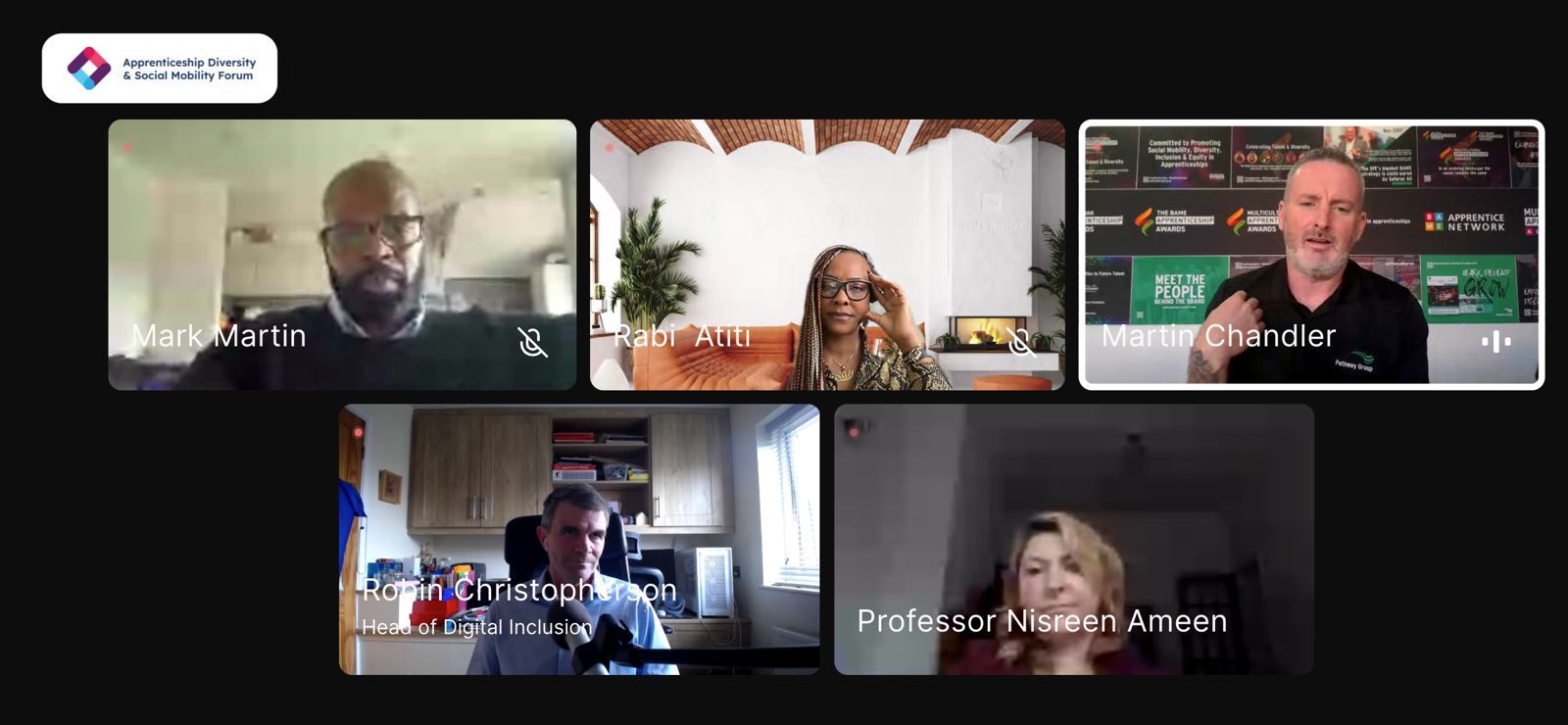
The panel featured Professor Dr Nisreen Ameen, Director of the Digital Organisation and Society Research Centre at Royal Holloway, University of London; Robin Christopherson MBE, Head of Digital Inclusion at AbilityNet; Rabi Atiti, Head of Inclusion for EMEA & India at Informa; and Mark Martin MBE, co-founder of UKBlackTech.
Across the conversation, one message consistently emerged: AI adoption must go beyond technology and be seen through a lens people and skills.
Who benefits from the AI transformation?
The discussion explored the changing nature of employment as AI becomes embedded within workplaces and the implications this could have for people who have historically faced barriers to opportunity.
AI has the potential to remove barriers, improve accessibility, personalise learning and give individuals new ways to develop and demonstrate their capabilities. At the same time, access to technology alone does not guarantee inclusion.
Participants considered what happens when access to AI tools, digital confidence, training and opportunities to experiment are distributed unevenly. If some employees and learners develop AI capabilities significantly faster than others, existing inequalities could potentially be reproduced within an AI-enabled economy.
This makes AI literacy increasingly relevant not only to digital and technology roles, but to apprenticeships, vocational education and workforce development more broadly.
Accessibility must be built in, not added later
Accessibility and digital inclusion formed another important part of the conversation.
Robin Christopherson MBE brought a particularly important perspective to the discussion around the potential for AI to improve accessibility and independence, while also highlighting why inclusive design needs to be considered from the beginning.
As AI increasingly influences recruitment, learning, workplace systems and everyday tasks, organisations need to consider whether those systems work effectively for people with different abilities, circumstances and ways of interacting with technology.
The wider discussion reinforced that inclusion should not become something organisations attempt to retrofit after AI systems have already been introduced.
Skills, confidence and the human advantage
The panel also considered how organisations should prepare their people for a workplace in which humans increasingly work alongside AI.
Rabi Atiti brought the conversation back to the importance of human capital and the relationship between technology and people. Rather than viewing AI purely through the lens of automation, the discussion explored how organisations can equip people to use technology to augment their capabilities while continuing to value distinctly human skills.
Professor Dr Nisreen Ameen contributed perspectives around AI adoption, skills, responsible innovation and workforce transformation, helping to connect the discussion around inclusion with the wider changes taking place across organisations and society.
Mark Martin MBE brought a further dimension through his experience in technology, education and UKBlackTech, including the importance of developing home-grown talent and ensuring that people from underrepresented communities are able to participate in the opportunities being created by emerging technologies.
Together, the discussion raised a broader challenge for employers, educators and policymakers. Preparing people for an AI-enabled economy cannot be limited to teaching people how to use individual tools. It also requires confidence, critical thinking, responsible use, accessibility and meaningful opportunities to apply AI within real work.
From conversation to action
For the Apprenticeship Diversity & Social Mobility Forum, the discussion reinforced why inclusion and social mobility need to remain central to conversations about the future of skills.
AI will continue to change occupations, workplace processes and the skills employers value. The challenge is to ensure that people from every background have a meaningful opportunity to participate in that transition.
That means employers thinking carefully about who receives AI training and development opportunities. It means training providers and educators considering how AI capability becomes part of learning. It also means policymakers considering how technological change interacts with existing inequalities in access, confidence and opportunity.
The objective should not simply be a more technologically capable workforce. It should be a workforce in which technological progress creates broader opportunity.
Thank you to our speakers and partners
We would like to extend our sincere thanks to Professor Dr Nisreen Ameen, Robin Christopherson MBE, Rabi Atiti and Mark Martin MBE for contributing their expertise, perspectives and experiences to such an important conversation.
We would also like to thank our Forum sponsors, Occupational Awards Limited (OAL) and Compass Group, for supporting the event and the wider work of the Apprenticeship Diversity & Social Mobility Forum.
OAL is a recognised awarding organisation and approved end-point assessment organisation working across a range of industry sectors. Compass Group operates apprenticeship programmes from Level 2 through to Level 6 as part of its approach to attracting new talent and supporting the development and progression of existing employees.
Finally, thank you to everyone who joined the Forum and contributed to the wider conversation.
The discussion about AI and inclusion is only beginning. As the technology develops, the Forum will continue to create space for employers, educators, policymakers, technology leaders and communities to examine what these changes mean for opportunity and social mobility.
The Apprenticeship Diversity & Social Mobility Forum will return in early December 2026, with further details to be announced shortly.